Biology of Transit
Traveling is a physiological stressor that disrupts the circadian rhythm and elevates cortisol. When you sit in a pressurized cabin at 30,000 feet, your lymphatic system stagnates and blood flow slows. Maintaining fitness while traveling isn't just about vanity; it’s about counteracting the inflammatory response of long-haul transit. Research from the Journal of Applied Physiology suggests that even five days of total inactivity can decrease insulin sensitivity by nearly 20%.
In my experience coaching consultants who spend 200 days a year in Marriott or Hilton properties, the most successful individuals don't "work out"—they implement "movement snacks." For instance, a 10-minute high-intensity isometric circuit in a cramped Tokyo hotel room can generate a post-exercise oxygen consumption (EPOC) effect that lasts for hours, effectively burning off that client dinner before it’s even served.
Real-world data shows that frequent travelers who maintain a bodyweight regimen report 30% higher energy levels and 25% better sleep quality compared to those who wait until they return home to resume their routine. The goal is maintenance and mitigation, not necessarily hitting a new deadlift personal record in a suite.
Travel Mindset Pitfalls
The most common mistake travelers make is the "vacation mode" mental shift. This psychological decoupling leads to the "de-training effect," where the body begins to shed muscle protein after just 72 hours of total inactivity. Many rely on the hotel gym, only to find it consists of a broken treadmill and a single pair of 5lb dumbbells, leading to frustration and a skipped session.
Another pain point is the "Carb-Loading Trap." Traveling often means disrupted meal timings and easy access to processed airport snacks. Without the metabolic "sink" of muscle contraction, these excess calories are stored immediately as visceral fat. I have seen executives lose three months of gym progress during a two-week European tour simply because they viewed movement as an "optional" rather than a "foundational" activity.
Physiological stagnation also leads to "Travel Brain"—that foggy, lethargic feeling caused by poor circulation and high cortisol. When you skip exercise, your body doesn't produce the BDNF (Brain-Derived Neurotrophic Factor) needed to stay sharp for high-stakes negotiations or complex itinerary management. The consequence is a downward spiral of poor food choices, caffeine over-reliance, and crashing energy.
Bodyweight Frameworks
The Power of Time-Under-Tension Isometrics
When you lack heavy weights, you must use physics to your advantage. Isometrics—holding a position under tension—recruit high-threshold motor units. A 60-second wall sit or a 90-second plank doesn't just burn calories; it signals the nervous system to maintain muscle density. Studies show that isometric training can also help lower blood pressure, making it a perfect antidote to the stress of flight delays.
Utilizing "Everyday Objects" as Resistance Tools
A standard hotel towel is an elite piece of equipment. By placing it on a hardwood or tile floor, you can perform "Towel Pikes" or "Lateral Lunges," introducing a friction-based instability that mirrors a Megaformer workout. This engages the adductors and deep core stabilizers that are often neglected in traditional gym settings. You can also use a heavy suitcase for "Suitcase Deadlifts" to maintain posterior chain engagement.
The 4-Minute Tabata Protocol for Metabolic Health
For those with zero time, the Tabata protocol (20 seconds of max effort, 10 seconds of rest, repeated 8 times) is the gold standard. Utilizing movements like burpees or mountain climbers, you can reach near-maximal VO2 levels. Using apps like SmartWOD or Tabata Timer helps maintain the strict intervals needed to trigger the metabolic shift. This is particularly effective for resetting your internal clock after crossing multiple time zones.
Unilateral Training to Address Muscle Imbalances
Traveling is the best time to focus on single-leg work. Bulgarian Split Squats (using the bed or a chair as a bench) and Single-Leg RDLs (Romanian Deadlifts) force the body to stabilize without needing external load. This prevents the "Pelvic Tilt" often caused by sitting in cramped economy seats for 10 hours. It turns a simple hotel floor space into a functional rehab clinic.
The "Grease the Groove" Method for Constant Readiness
Instead of one 60-minute session, perform 10 push-ups every time you go to the bathroom or 20 squats every time you check your email. This method, popularized by strength coach Pavel Tsatsouline, keeps the neuromuscular pathways "hot." It prevents the stiffness associated with sedentary travel days and ensures you hit a significant volume of movement by the end of the day without ever breaking a sweat.
Mobility Flows for Circadian Alignment
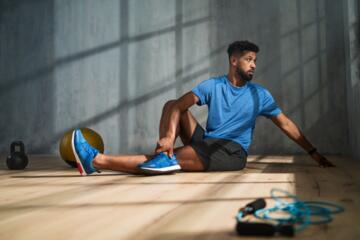
Movement is a primary "Zeitgeber" (time-giver) for your body. Performing a 10-minute flow—incorporating "The World's Greatest Stretch" and "90/90 Hip Switches"—first thing in the morning signals to your brain that the day has started. Apps like GOWOD or Pliability offer travel-specific routines that focus on decompressing the spine and opening the hip flexors after long flights.
Bodyweight routines are great on the road, but if you want more consistent progress at home, setting up a home gym on a budget gives you the missing piece without breaking the bank.
Performance Recovery
Case Study 1: The Global Consultant
A senior partner at a "Big Four" firm struggled with weight gain during a 3-month project in Dubai. We implemented a "Floor-Only" 15-minute routine: 3 rounds of 50 air squats, 30 push-ups, and a 1-minute plank, performed immediately upon waking.
Result: He lost 4kg of body fat over 12 weeks despite eating at high-end restaurants, purely by maintaining his basal metabolic rate (BMR) through daily morning spikes.
Case Study 2: The Tech Nomad
A software engineer traveling through Southeast Asia had no access to gyms. We utilized the "Backpack Method"—filling a 40L Osprey bag with water bottles and books for resistance. We tracked progress using the Strong app.
Result: He maintained his bench press and squat numbers for 6 months using only backpack-weighted push-ups and lunges, proving that load is load, regardless of the source.
Analysis of Approaches
| Method | Time Investment | Primary Benefit | Best For |
|---|---|---|---|
| Tabata / HIIT | 4–10 Minutes | Cardiovascular & Metabolic Spike |
Tight schedules, jet lag recovery |
| Unilateral Strength | 20–30 Minutes | Muscle Maintenance & Balance |
Long-term travel, injury prevention |
| Mobility Flows | 10–15 Minutes | Joint Health & Stress Reduction |
Post-flight recovery, morning routine |
| Grease the Groove | Intermittent | Neuromuscular Tone | Airport layovers, office days |
Avoiding Workout Pitfalls
The biggest error is ignoring the "Surface Factor." Doing high-impact plyometrics on hard hotel tiles can lead to shin splints. Always opt for the carpeted area or use a towel as a makeshift mat. Additionally, don't underestimate the dehydration of travel. For every hour spent in flight, drink at least 250ml of water with electrolytes (like LMNT or Liquid I.V.). Exercise in a dehydrated state is less effective and increases the risk of fainting.
Another mistake is "Routine Rigidity." If you usually spend 90 minutes in the gym, don't try to replicate that in a hotel. You will likely quit after two days. Shorten the duration but increase the intensity. Focus on "Quality over Quantity." If you can do 50 push-ups, do them with a 3-second descent to increase the stimulus. Adaptability is the ultimate fitness skill for any traveler.
FAQ
Can I actually maintain muscle without weights?
Yes. Hypertrophy (muscle growth) is a result of mechanical tension and metabolic stress. By using slow eccentrics (lowering phase) and high repetitions to failure, you can provide enough stimulus to maintain and even grow muscle using just bodyweight.
How do I stay motivated when I’m exhausted from jet lag?
Use the "5-Minute Rule." Commit to just 5 minutes of movement. Usually, once the blood starts pumping and endorphins are released, you’ll find the energy to finish a full 15-minute set. Movement is often the cure for fatigue, not the cause.
What are the best movements for a small hotel room?
Focus on vertical movements: Air squats, reverse lunges, push-ups, and planks. These require no more than a 2x2 meter space. Avoid movements that require running or jumping if you are worried about noise or space constraints.
Is it better to workout in the morning or evening while traveling?
Morning is generally better for travelers. It ensures the workout is done before the day’s unpredictable schedule takes over, and the morning light exposure helps reset your circadian rhythm to the new time zone.
Do I need to track my travel workouts?
Absolutely. Using an app like MyFitnessPal or a simple notebook keeps you accountable. Seeing a streak of "5-minute hotel sessions" provides a psychological win that keeps you consistent throughout your trip.
Author’s Insight
I have spent the last decade perfecting the art of the "Invisible Gym." My biggest takeaway is that your body doesn't know the difference between a $2,000 barbell and a strategically executed slow-motion push-up; it only knows tension and demand. I always pack a lacrosse ball for self-myofascial release and never rely on the hotel's facilities. My personal "golden rule" is to never spend more than two days in a row without breaking a sweat, regardless of what continent I'm on. This consistency is what separates those who return home exhausted from those who return ready to hit the ground running.
Summary
Fitness while traveling is not about finding the perfect gym; it is about leveraging your environment and understanding basic human physiology. By focusing on high-intensity intervals, unilateral strength, and consistent mobility, you can mitigate the negative effects of travel and maintain your hard-earned progress. Start small, stay consistent, and remember that any movement is infinitely better than no movement. Your next trip is an opportunity to prove that your health is not location-dependent.